












When Humans do Human things and Machines do Machine Things
Kshira Saagar, Head of Analytics & Data Science, THE ICONIC

Kshira Saagar, Head of Analytics & Data Science, THE ICONIC
Introduction
The word 'simulation' in itself has come a long way etymologically; initially used to mean a fake profession in the dark ages, later used to denote an imitation during renaissance, and finally in the golden age of the computers, it came to mean a model or mock up that resembles reality. In the same vein, the application of simulation in analytics has come a long way too.
Simulation is usually stereotyped to be associated with high performance computing, heavy number crunching, and algorithmic wizardry. Although there’s an element of truth to this association, it would be true to say that simulation can help in a totally different realm—the business of making mundane business intelligence (BI) work non-existent and accelerating decision making from reports. But how? Let’s have a look into this topic in detail.
Data-decision Supply Chain
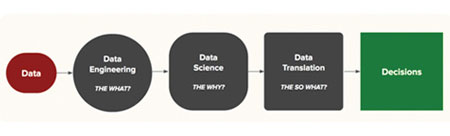
In the journey to get from raw data to effective decisions, there is a small supply chain consisting of three key components—data engineering, data science, and data translation. Data engineering gets data from A to B in shape, with credibility and at scale. Data science applies intelligence to data by detecting patterns and quantifying drivers, again at scale. Data translation is the part where all this math and tech need to be translated back into English for the business to make a decision.
This part of the supply chain is the one that can’t be done at scale so easily due to the nature of how business interacts with data and the only way businesses scale this part is by assigning more people in the BI teams churning one report after another like good old industrial revolution days. Interestingly, the rate of production of reports can never match or overtake the rate of business asking questions and changing their minds about things.
Ergo, this part of the supply chain—the part where math, tech, and data need to be translated into actionable decisions is the part where simulation fits in perfectly, like a match made in heaven.
Simulation’s Role in Decision Making
Let’s look at an example to solidify this further - a marketing team has a finite marketing budget and has an eternal question, “where should we spend my money and what is the best way to do it”. Businesses and data teams approach this in two ways - brute force or brain force.
Brute force—this is when the teams produce 10x or more individual channel level reports that each have at least 50-odd key metrics broken down by day, week, and month, each replete with graphs and dials, all of them looking at each channel with superb granularity. Instead of being able to make a decision, the business user drowns in a data tsunami, while the team producing the reports on the other hand barely manage to extract anything ‘intelligent’ because they are too spent on getting the reports out in time.
Brain force—the team decides it is high time to get a technical PowerPoint or memo that details the impact each channel has on one another and the potential return on investment of spending a fixed budget on a certain mix. However, remember the brain force way makes it far more statistical and mathematical, leaving the business user with an academic research paper that is good to hold and discuss, but offers no tangible immediate actionable value.
Why does this breakdown happen? Because the only thing a marketer or business user is concerned about, is what to do next? And why?
This is where simulation steps in.
Simulation is the beautiful baby of brute force and brain force. If reports are built in a way, where a user can not only look at key performance metrics and various breakdowns, but also incorporate the model workings in the backend as parametrized values - a marketer can be allowed to enter any budget they have in mind, pull any lever they feel is relevant and see how all of this ends up as a final result through a simulated report on eventual performance.Not only do Markov and Bayesian models need simulations and random walks to come up with an optimal solution, but also does BI. Simulation drastically reduces the lead time from question to answer, by removing the need for analysts to go away and answer a simple question of “What if this factor changes by 3 percent…” - reports and dashboards baked in with simulating calculators hugely enhance the productivity of all teams involved.
Apart from an increase in productivity and overall efficiency of decision making, simulation also plays a key role in employee happiness. If humans are no longer needed to re-run the same old analyses with minor changes again and again, they can spend their time on more rewarding and intellectually challenging problems that can yield a more favourable view of each person’s work.
Summary
There’s a strong belief at THE ICONIC that humans should do what humans do best (which is think and innovate), and machines should do what machines do best (which is automate repetitive tasks and answer simulated what-if questions). This helps the business make decisions in real time – rather than months down the track when it’s no longer useful or relevant.

